
Announced Is Not Verified: A Five-State Ladder for Grading What a Company Says It Did
Diligence trackers usually record whether a claimed corporate initiative was announced or delivered, but not how strong the evidence behind that label actually is — here is a five-state disclosure ladder analysts can apply to any company's claimed wins themselves.
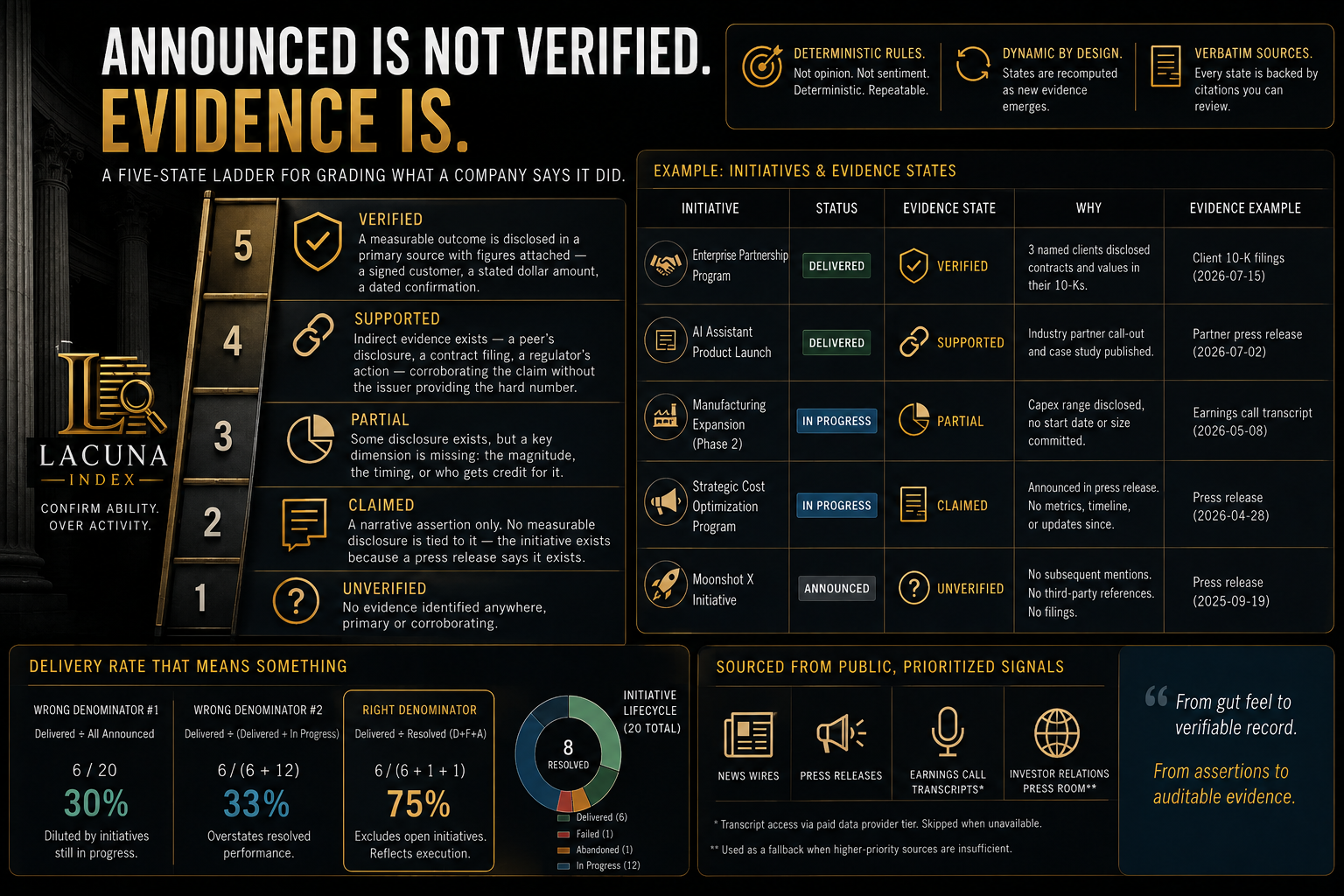
Announced Is Not Verified: A Five-State Ladder for Grading What a Company Says It Did
Every earnings call and press release cycle produces a fresh stack of claimed wins: a new enterprise client, a cost-cutting program, an artificial-intelligence product rollout, a manufacturing expansion. Diligence analysts read these the same way they read everything else management publishes — as a single undifferentiated stream of "things the company says." But "we launched an enterprise partnership program" and "we signed three named enterprise clients who each disclosed contract value in their own filings" are not the same claim wearing different clothes. One is a sentence. The other is evidence. Most tracking spreadsheets don't have a column for the difference, so they don't record it, and six months later nobody can tell which initiatives on the list were ever actually confirmed.
Lacuna Index tracks corporate initiatives the same way most diligence teams do — status labels like "delivered," "failed," "abandoned," "in progress." But status alone answers only "what did the company say happened," not "how do we know." So the initiative record carries a second, independent field: an evidence state, graded on a five-step ladder, that answers the second question without touching the first.
The ladder
The five states, in order from strongest to weakest support:
| State | What it means |
|---|---|
| Verified | A measurable outcome is disclosed in a primary source with figures attached — a signed customer, a stated dollar amount, a dated confirmation. |
| Supported | Indirect evidence exists — a peer's disclosure, a contract filing, a regulator's action — corroborating the claim without the issuer itself providing the hard number. |
| Partial | Some disclosure exists, but a key dimension is missing: the magnitude, the timing, or who gets credit for it. |
| Claimed | A narrative assertion only. No measurable disclosure is tied to it — the initiative exists because a press release says it exists. |
| Unverified | No evidence identified anywhere, primary or corroborating. |
The important design choice is what determines the state. It isn't a subjective read of tone or a language-model's judgment call — it's a deterministic rule applied to a fixed set of fields already on the initiative record: whether an actual outcome was stated, whether named clients or counterparties are attached, whether an outcome-verification date exists, whether a timeline was promised. "Delivered" plus a stated outcome plus a named client or a verification date is Verified. "Delivered" with a stated outcome but nothing to independently anchor it is Supported. A claim that's still "in progress" with no client names, no last-seen update, and no timeline sits at Claimed — announced, and nothing since.
That determinism matters for a reason specific to diligence work: the classification is recomputed every time the record is displayed, not stored as a frozen judgment from whenever an analyst first logged the initiative. If a named client later surfaces in a subsequent quarterly filing, the same initiative flips from Claimed to Verified automatically, without anyone re-running an analysis. The record doesn't get stale in the direction that matters most — it doesn't keep crediting a company with "delivered" status on the strength of a two-year-old press release nobody has re-checked.
The denominator problem in "X% delivered"
The other habit worth stealing directly: how the roll-up success rate is computed. It would be easy to report delivered initiatives as a share of everything ever announced, but that number gets diluted by initiatives still in progress that haven't had time to succeed or fail yet — a company that announces aggressively and resolves slowly would look artificially disciplined. Instead, the rate is delivered divided by resolved initiatives only — delivered, failed, and abandoned — excluding anything still open. A company with twenty initiatives on file, twelve still in progress, and a 6-of-8 record on the ones that actually reached a conclusion reports 75%, not 30% and not 60%. Either of the wrong denominators tells a defensible-sounding but misleading story. When a company or a data vendor hands you a headline "X% initiative delivery rate," the first diligence question is which of these three numbers it actually is.
Where the raw material comes from — and where it doesn't
It's worth being specific about sourcing, because the ladder is only as good as what feeds it. Claimed-initiative extraction pulls from a prioritized stack of public sources: news wire coverage, press releases, earnings-call transcripts, and — as a fallback — a scrape of the issuer's own investor-relations press room. Transcripts in particular are gated behind a paid data-provider tier and are skipped silently when unavailable, so the pipeline keeps running on news and press releases rather than failing outright. That's a reasonable engineering trade-off, but it means initiative coverage for a given company can be thinner in a period where transcript access lapsed — worth checking before treating an "Unverified" state as proof of absence rather than absence of proof.
What to take from this
You don't need Lacuna's database to use the ladder. The next time a target company's investor deck lists "key initiatives," run each one through the same five questions before it goes in your model: Is there a stated outcome with a number attached? Is there a named counterparty or a corroborating third-party disclosure? Is the timing and magnitude both specified, or just one? Or is the entire entry supported by nothing but the sentence announcing it? A slide of fifteen initiatives that resolves to two Verified, three Supported, and ten Claimed is a very different underwriting input than the same slide treated as fifteen equally credible facts — and the gap between those two readings is exactly the kind of thing a diligence process exists to catch before the market re-rates it.