
The Capital-Discipline Floor: Why a Profitable Core Can't Buy Cover for an Unprofitable Bet
When one segment prints most of the profit and another burns billions with no path to breakeven, LacunaIndex's scoring methodology nets the two for operating execution but refuses to net them for capital-allocation accountability once a fixed loss threshold is crossed.
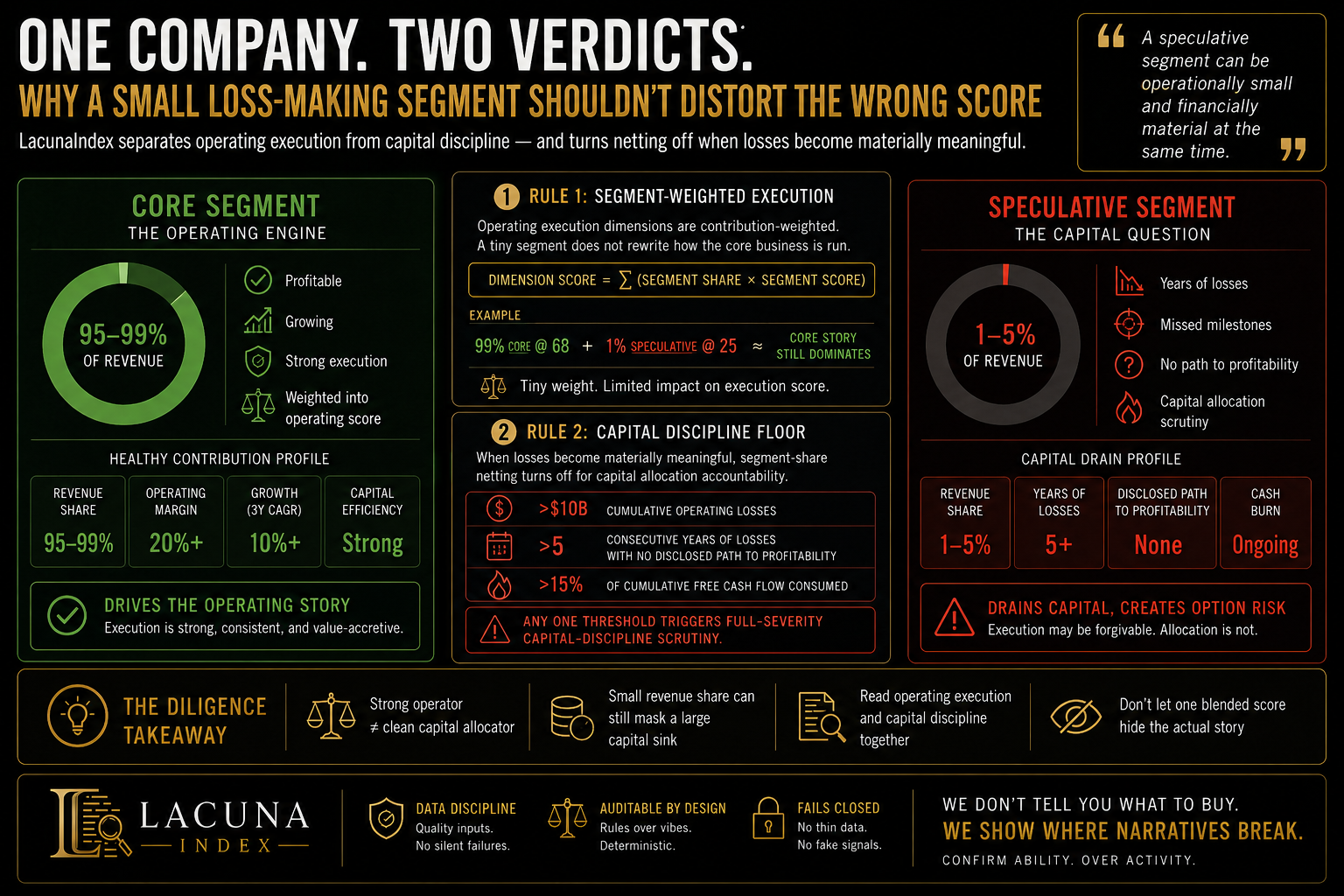
The diligence problem
A diversified company reports two segments. One is enormous, profitable, and growing. The other is small by revenue, structurally unprofitable, and has been burning cash for years with no disclosed date for turning a profit. How should a single operating-execution score treat that company?
There are two bad defaults. The first is to average the two segments by weight and call it a day — which is roughly fair for describing how well the company runs its actual business, but quietly launders the loss-making segment's track record into a footnote. The second is to let the loss-making segment's forensic pattern (missed milestones, restated targets, programs that quietly stopped being mentioned) drag the whole operating score down, even though it may only be a few percent of revenue — which mischaracterizes a healthy operator as a weak one.
LacunaIndex's scoring methodology, encoded directly in the prompt logic that generates issuer reports (src/integrations/supabase/lacuna-reports.ts), resolves this with two rules that are deliberately asymmetric: segment-share netting for how the business is run, and a hard floor that turns netting off for how capital is allocated, the moment a segment's losses cross a fixed materiality line.
Rule one: segment-weighted execution
For any issuer that discloses two or more operating segments, seven "operating execution" dimensions — financial delivery, narrative honesty, artificial-intelligence (AI) credibility, client validation, executive accountability, disclosure quality, and moat durability (how durable the company's competitive advantage is) — must be scored as a contribution-weighted blend, not a single holistic guess:
dimension_score = Σ (segment's share of revenue or operating income × that segment's dimension score)
The logic in the prompt is explicit that a speculative, pre-revenue, or under-5%-of-revenue segment is "a capital allocation question, not an operating execution question," and that its losses "must not be allowed to drag the operating execution score below the contribution-weighted blend of the segments that actually produce the revenue." The methodology's own worked example, written directly into the scoring instructions, illustrates the arithmetic with a hypothetical two-segment company: a 99%-of-revenue core segment scored 68 and a 1%-of-revenue speculative segment scored 25 blend to 67.6, rounded to 64 after a separate governance adjustment. The point isn't the specific numbers — it's that a large, low-scoring outlier at a trivial revenue share can move the blended score by only a fraction of a point, by construction.
Rule two: the floor that turns netting off
That relief has a limit, and the limit is where this gets interesting for diligence work. The same section of scoring logic defines a capital discipline floor: once a speculative segment has crossed any one of three disclosed thresholds —
- more than $10 billion in cumulative operating losses,
- more than five consecutive years of segment operating losses with no disclosed path to profitability, or
- more than 15% of the company's cumulative free cash flow (cash generated by the business after covering its own operating and capital needs) consumed over the look-back window —
— the segment-share discount stops applying to capital-allocation accountability, full stop, regardless of how small the segment's revenue share is. Three consequences follow automatically, per the prompt logic:
- The capital-allocation dimension's
named_investmentsentry must name the segment explicitly, with a return-on-investment (ROI) assessment stating cumulative dollars invested against disclosed return, and the overall verdict must name the dollar magnitude. - Every dated milestone inside that segment that slipped, was quietly restated, or simply stopped being mentioned in subsequent disclosures scores at full severity in the abandoned-initiatives and promise-decay dimensions — the segment-share weighting that softens the operating-execution score does not apply here.
- The ambition-versus-ROI comparison must explicitly set the company's own prior multi-year capital commitments to the segment against the return actually realized, with dates and figures.
The intended output, stated directly in the scoring instructions, is a specific verdict shape: a profitable operator running a large, sustained, unprofitable bet should read as a healthy operating engine with a clearly flagged capital-discipline history — not as a weak operator across the board, and not as a clean operator with no capital-allocation memory either.
Why this is a diligence primitive, not a stylistic choice
Every buy-side analyst has had the argument about how much a loss-making division should matter to the investment case. "It's only 2% of revenue" and "they've burned ten billion dollars with no exit plan" are both true and both, on their own, incomplete. What LacunaIndex's methodology does is make that argument mechanical and auditable rather than a matter of house style: the netting threshold, the loss thresholds that shut netting off, and the specific fields that must be populated once they're crossed are all fixed in the scoring logic and disclosed the same way for every issuer, not adjusted case by case for how sympathetic the story is.
That has a direct implication for how to read any LacunaIndex report on a multi-segment issuer. If the operating-execution dimensions look strong while the capital-allocation dimension carries a specific, dollar-denominated write-up of a named segment, that is not an inconsistency — it is the framework working as designed, separating "can this company run its core business" from "has this company been disciplined with the capital it has put behind a bet." Reading the two verdicts together, rather than collapsing them into one blended number, is where the framework's real signal for a speculative-segment story sits — and it's a check any analyst can reproduce by pulling the segment-level operating loss and free-cash-flow figures directly from the issuer's own annual filing.