
No More Ghost Executives: Why Leadership Claims Need a Disclosure Trail, Not a Personality Label
When an AI-generated report calls an executive a "ghost" or scores them as a personality archetype, a diligence analyst has no way to check the claim against a filing -- LacunaIndex retired those labels and rebuilt leadership analysis around five disclosure-anchored fields instead.
No More Ghost Executives: Why Leadership Claims Need a Disclosure Trail, Not a Personality Label
Ask any diligence analyst what they distrust most about artificial intelligence (AI) generated equity research, and leadership commentary is usually near the top of the list. A tool that tells you a chief executive officer (CEO) is a "visionary" or a chief financial officer (CFO) is "underwhelming" has handed you an opinion, not evidence. You cannot cite it in an investment memo, you cannot trace it to a source, and if it turns out to be wrong you have no way of knowing why the model said it in the first place.
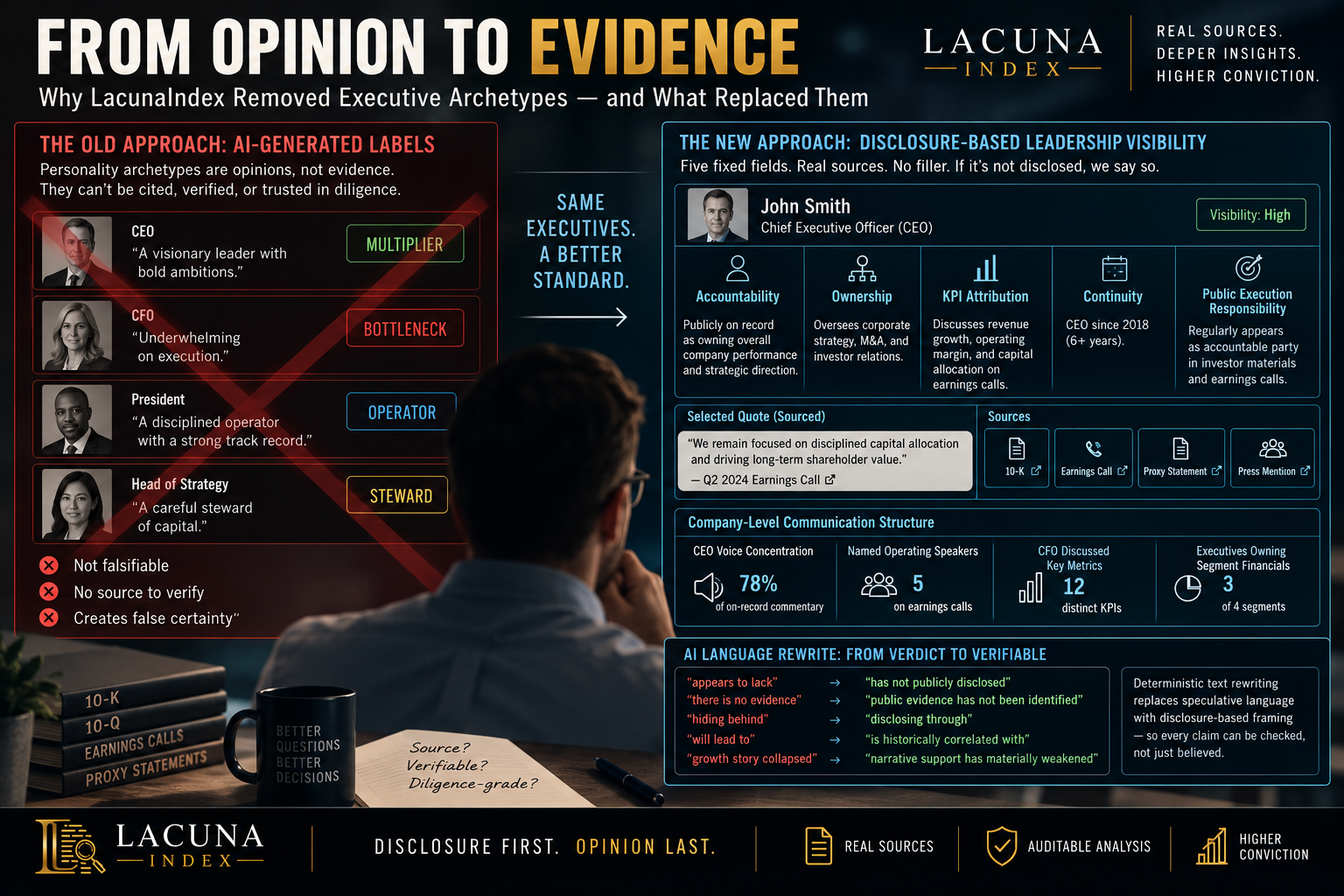
LacunaIndex, an equity research platform that generates company reports from public filings, earnings call transcripts, and other disclosure sources, ran into this problem directly -- with its own product. An earlier version of its issuer reports scored each member of a company''s executive leadership team against a fixed set of personality labels: MULTIPLIER, OPERATOR, STEWARD, BOTTLENECK. The current codebase has since removed that feature. A comment left in the source code where the badge used to render explains why: "Archetype badge removed -- disclosure-anchored card no longer asserts speculative role labels." That single deletion is a useful case study in a question every diligence analyst evaluating an AI research vendor should be asking: what happens when a language model''s output can''t be checked against a source?
The problem with an archetype
A personality-style label like "bottleneck" or "operator" is a conclusion, not a data point. It compresses a mix of tone, phrasing, and pattern-matching from a large language model (a type of AI system trained to generate text, abbreviated LLM) into a single word that reads as authoritative but isn''t independently verifiable. Two problems follow directly from that:
- It isn''t falsifiable. There is no filing, transcript, or public statement an analyst can point to that either confirms or refutes "this executive is a bottleneck." The label exists only inside the model''s output.
- It can misrepresent risk as certainty. A label applied consistently across hundreds of companies looks systematic, which makes it easy to over-trust -- even though the underlying judgment is exactly as soft as a single adjective.
For a research product whose entire value proposition rests on being usable in a due diligence process, that''s a real liability, not just a stylistic quibble.
What replaced it: five fixed, disclosure-anchored fields
LacunaIndex''s current leadership section -- labeled in the product as "Disclosure-Based Leadership Visibility" -- scores each named executive against five fixed fields instead of a personality type:
- Accountability -- who is publicly on record as owning a given outcome
- Ownership -- what the executive is documented as controlling (a segment''s financials, a product line, a function)
- Key performance indicator (KPI) attribution -- which metrics the executive has been publicly tied to
- Continuity -- tenure and stability signals
- Public execution responsibility -- whether the executive appears as an accountable party in investor-facing materials, not just an org chart
Each field either resolves to a specific, sourced observation or renders the literal text "Not publicly disclosed." There is no filler. If a company hasn''t put an executive on the record for a given dimension, the report says so instead of guessing.
Each executive row also carries a visibility tier -- High, Moderate, Limited, or Non-visible -- and a list of the actual sources (earnings call, proxy statement, press mention, conference appearance) the row is built from, linked out by domain. An analyst reading the report can click through to the underlying disclosure rather than trusting the summary.
The panel also surfaces company-level "communication structure" metrics that are themselves just counts, not judgments: CEO voice concentration as a percentage of on-record commentary, the number of named operating speakers on earnings calls, how many key performance indicators the CFO is on record discussing, and how many executives are documented as owning a business segment''s financials. A company where one voice accounts for 90% of public commentary looks different from one with five named operating leaders -- and that difference is visible in the numbers rather than asserted in prose.
Suppressing the quote when there''s nothing behind it
One specific rule in the underlying code is worth calling out because it''s the kind of thing that''s easy to skip and hard to notice is missing: an executive quote is only displayed if it has real evidentiary backing -- at least one earnings call appearance, a proxy or annual report (Form 10-K, the annual report U.S. public companies file with the Securities and Exchange Commission) mention, a press citation, or a conference appearance -- and only if the quote carries a named source. A quote with zero backing on any of those counts is treated as likely paraphrase rather than a genuine statement, and the interface simply doesn''t render it. That''s a narrow rule, but it closes off one of the more common failure modes in AI-generated research: a plausible-sounding quotation attributed to a real person that the person never actually said.
A second layer: rewriting the model''s own language after the fact
Beyond restructuring what data leadership analysis is built from, LacunaIndex runs a separate, deterministic pass over all generated report text -- not just the leadership section -- that rewrites specific categories of phrasing before a report is finalized. This isn''t another AI model making a second pass; it''s a fixed set of text substitutions applied the same way every time, so the same input always produces the same output. A few examples of what gets rewritten:
- "appears to lack" becomes "has not publicly disclosed"
- "there is no evidence" becomes "public evidence has not been identified"
- "hiding behind" becomes "disclosing through"
- "celebrity CEO" becomes "communication-concentrated CEO"
- "will lead to" / "guarantees" / "proves" become "has historically been associated with" / "is historically correlated with" / "is consistent with"
The pattern across all of these substitutions is the same: causal and character-based framing gets converted into correlational, sourced, or disclosure-based framing. A model might still be tempted to write that a company''s growth story "collapsed" -- the sweep converts that to "narrative support has materially weakened," which is a claim that can actually be checked against subsequent disclosures, rather than a verdict that can only be agreed with or dismissed.
What this should prompt you to ask your own AI research vendors
None of this means the underlying language model behind a research report always gets it right, or that a disclosure-anchored framework eliminates the need for an analyst''s own judgment. What it does is make errors checkable. If a report says an executive''s public execution responsibility is "not publicly disclosed," you know exactly what that claim rests on: an absence, not an inference. If it says CEO voice concentration is 78%, that''s a number you can sanity-check against the same earnings call transcripts the platform used.
The broader lesson for anyone evaluating AI-assisted research tools in a diligence workflow: ask whether a claim about a person or a company resolves to a source, or only to a label. A personality archetype, a tone-based descriptor, or an unqualified verdict ("management has failed to deliver") is a dead end -- there''s nowhere to go to check it. A field that says "not publicly disclosed," a percentage tied to a transcript, or a quote with a named source is not. The difference isn''t stylistic. It''s whether the output can survive being put in front of an investment committee that will ask, reasonably, "how do you know that?"