
Scheduled Sale or Signal? Why Insider Selling Needs a Rule 10b5-1 Split Before It Means Anything
Buy-side analysts treat a headline insider-sale number as a single data point, but pre-scheduled Rule 10b5-1 trades and discretionary trades carry opposite signal value, and LacunaIndex's Form 4 pipeline tags every transaction with its plan status so the two never get averaged into a false signal.
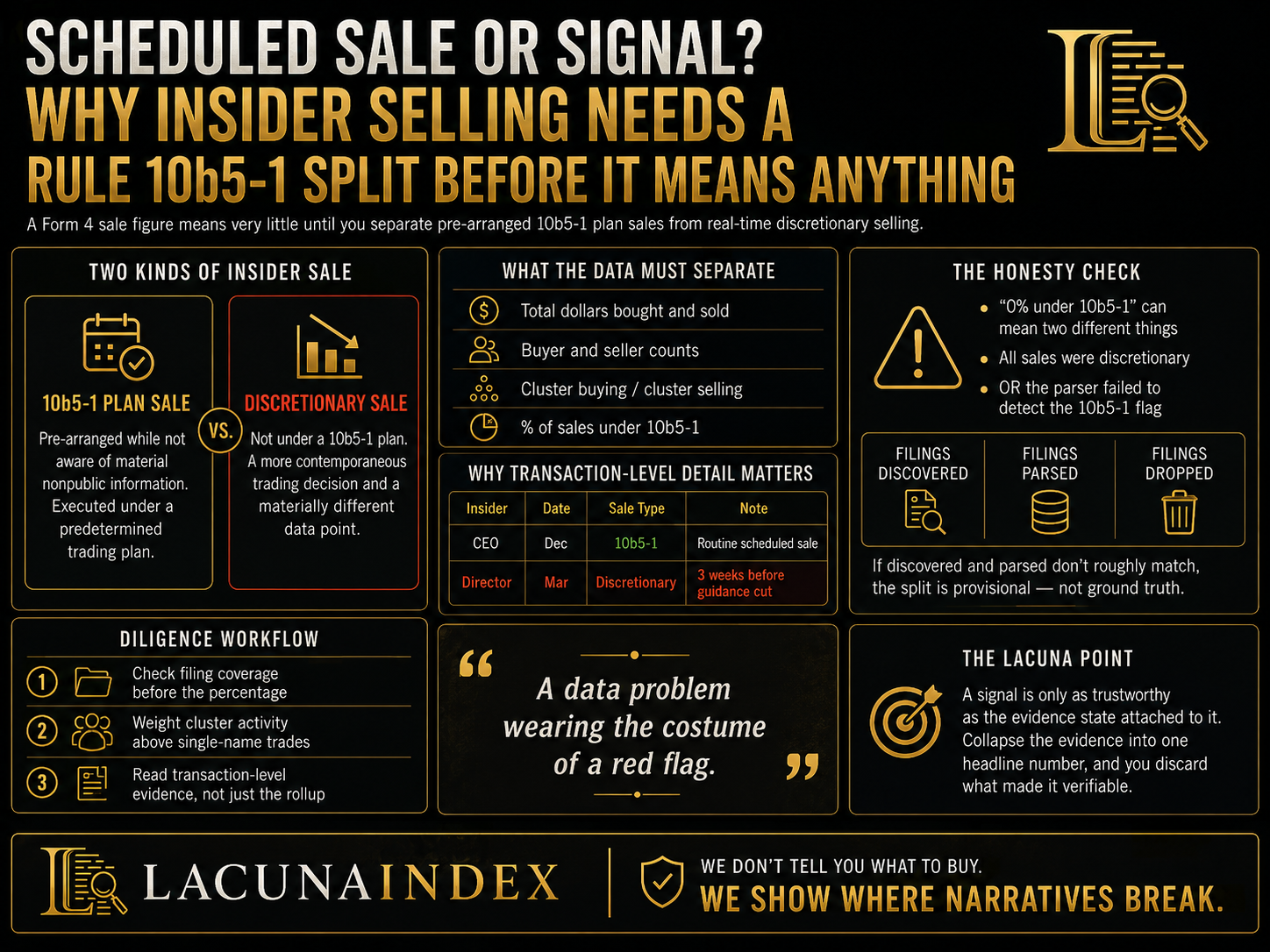
Scheduled Sale or Signal? Why Insider Selling Needs a Rule 10b5-1 Split Before It Means Anything
A headline like "CEO sold $12 million in stock last quarter" gets read as one number with one meaning: an insider cashed out, so maybe something's wrong. In practice, that single dollar figure can hide two almost opposite stories, and a diligence process that doesn't separate them is scoring noise as if it were signal.
Two kinds of insider sale
When a company insider — an executive or director — buys or sells shares, U.S. securities law requires them to report it to the Securities and Exchange Commission (SEC, the federal regulator for public markets) on a document called a Form 4. Most Form 4 datasets stop there: a name, a date, a dollar amount, a running total.
What they don't tell you, unless you go looking, is how the trade was authorized. Rule 10b5-1 is an SEC rule that lets an insider set up a pre-arranged trading plan — a schedule of future buys or sells, locked in while the insider is not in possession of material non-public information, and then executed automatically on that schedule regardless of what happens to the stock afterward. A sale under a 10b5-1 plan is closer to an automated payroll deduction than a decision made this week. A sale with no such plan behind it — a discretionary trade, made in real time, with full knowledge of what's happening inside the company — is a different kind of data point entirely.
Averaging the two into "$12 million sold" throws away the one distinction that made the number worth looking at in the first place.
How the data is actually structured
LacunaIndex's issuer reports carry an insider_activity section built specifically around this split, and it's worth walking through the shape of it because the granularity is the point.
At the top level, the section aggregates net dollars bought and sold, a count of insiders who traded, separate buyer and seller counts, and a cluster_buy flag that fires when multiple insiders are buying in the same lookback window — a materially stronger signal than one executive's trade, since it's harder to explain away as personal liquidity or tax planning. There's also a headline aggregate, pct_sales_under_10b5_1, giving the share of sold value that was executed under a scheduled plan versus sold at will.
But the aggregate isn't where the real evidence lives. Underneath it, every insider has a list of individual transactions, and each transaction carries its own plan flag — not just the rollup. That per-trade detail is what lets a report say, for example, that a CEO's routine December sale was 100% scheduled while a director's March sale, three weeks before a guidance cut, was not.
The honesty check built into the schema itself
Here's the part worth calling out directly, because it's a level of self-scrutiny you don't usually see documented: the schema definition for this section includes a note warning that a pct_sales_under_10b5_1 reading of zero can mean two very different things. It can mean every sale in the window really was discretionary — a genuine signal. Or it can mean the Form 4 parser failed to detect the 10b5-1 checkbox on the filing and never set the flag at all — a data problem wearing the costume of a red flag.
The schema doesn't hide that ambiguity behind a clean number. It carries three coverage counters alongside the trading data — filings discovered, filings parsed, and filings dropped — specifically so a reader can check pipeline coverage before trusting the percentage. It also carries the filer's Central Index Key, the SEC's numeric identifier for the entity, and an optional note field for anything that didn't resolve cleanly. If discovered and parsed don't roughly match, the plan split for that issuer isn't ground truth yet — it's provisional, and should be treated that way until the coverage gap closes.
What this means for a diligence workflow
If insider trading data feeds into your process today, three checks are worth adding before a "0% under a 10b5-1 plan" figure gets treated as a discretionary-selling red flag:
- Check filing coverage before the percentage. If filings discovered and filings parsed diverge meaningfully, the plan-status split is incomplete, not necessarily damning.
- Weight cluster buying and selling above single-name trades. One insider's trade, scheduled or not, is a weaker signal than multiple insiders moving in the same direction in the same window.
- Read the transaction level, not just the rollup. A single unscheduled sale timed close to a disclosure event tells you more than an aggregate dollar figure ever will — the aggregate is a starting point for the question, not the answer to it.
The broader point isn't specific to Form 4 filings. It's the same discipline that shows up across LacunaIndex's methodology: a claim, a score, or a trade is only as trustworthy as the evidence state attached to it, and the moment you collapse that evidence state into a single headline number, you've thrown away the thing that made it verifiable in the first place.