
The Pressure Test: Turning a Growth Narrative Into a Falsifiable Claim
Diligence analysts need a fast way to tell whether a company's growth story is testable or just persuasive, and LacunaIndex's Pressure Test module answers that by matching each claim to one of seven named historical failure patterns and naming the exact disclosure that would rebut it.
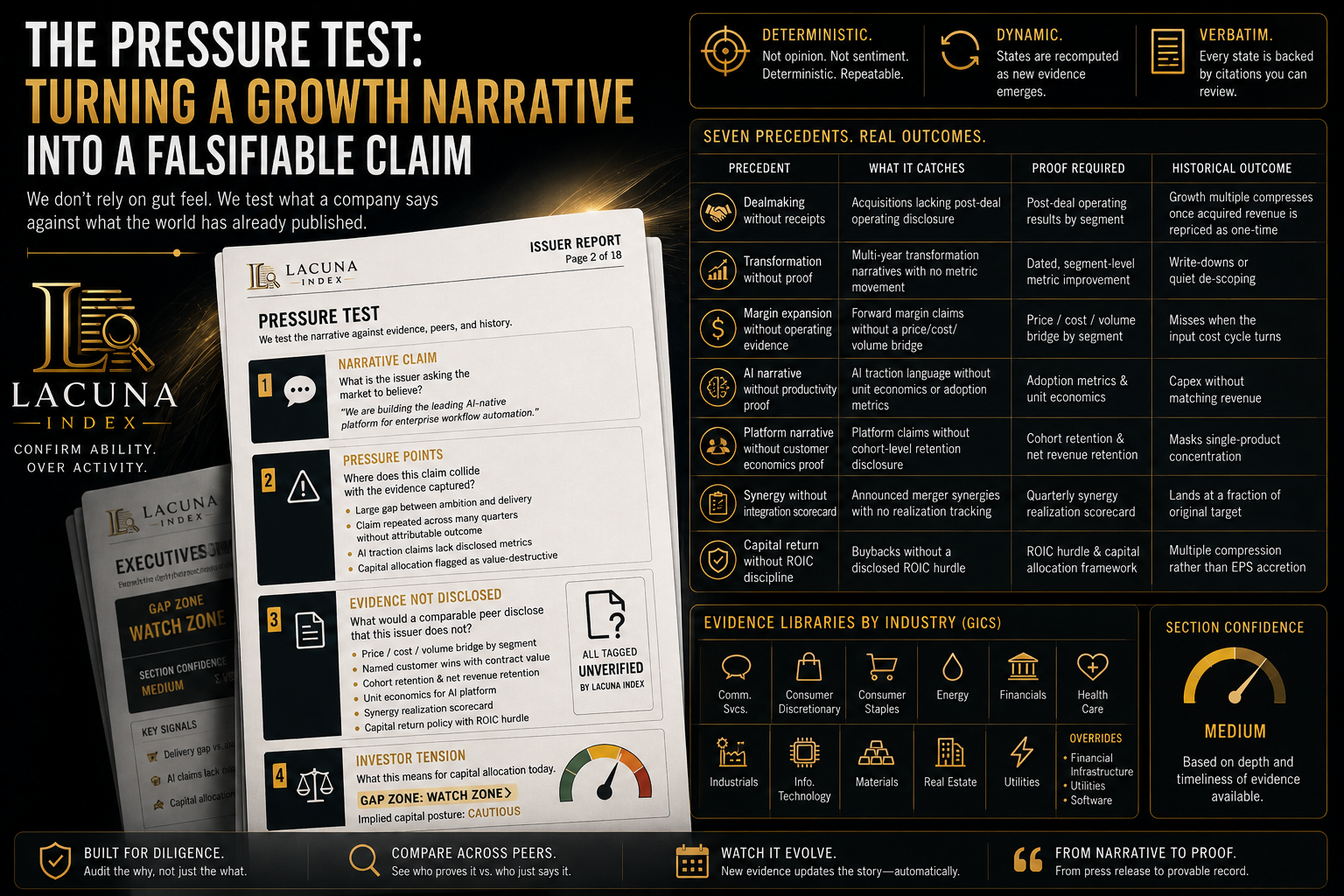
The Pressure Test: Turning a Growth Narrative Into a Falsifiable Claim
Every coverage list has a name where the shareholder letter reads well and the model doesn't quite believe it. The language is confident, the "transformation" or "platform" or "AI" story is coherent on the page, and yet something about it resists being pinned down enough to underwrite a position size. The usual fix is to read three more years of transcripts and hope the discomfort turns into something citable. LacunaIndex takes a narrower approach: instead of asking "does this feel credible," it asks "what would have to be true, what would a credibly-disclosed peer have already published, and which specific companies made this same claim before and how did it end."
That logic lives in a report block called the Pressure Test, and it's worth describing in detail because it's one of the more mechanical, and therefore more auditable, pieces of the platform's output.
Four questions, in a fixed order
Every LacunaIndex issuer report carries a Pressure Test section — page two of the exported report (a Portable Document Format, or PDF, file) and the top of the executive summary in the browser view. It always answers four questions, in this order:
- Narrative claim — what is the issuer asking the market to believe? This is pulled directly from the company's own stated vision, best-articulated language, or one-line summary — not a paraphrase the model invented.
- Pressure points — where does that claim collide with the evidence already captured? A large gap between stated ambition and demonstrated delivery, a claim repeated across many quarters without an attributable outcome, a named investment flagged as value-destructive, or a forward ambition rated as overreaching relative to the current operating base.
- Evidence not disclosed — specific, named items (not "more disclosure, please" but "a price/cost/volume bridge by segment," for example) that a comparably-disclosed peer in the same industry would publish and this issuer does not.
- Investor tension — what this means for capital allocation today, tied to the platform's gap-zone classification (aligned, healthy tension, watch zone, or narrative danger) and an implied capital posture.
The part worth dwelling on is how items 2 and 3 get built, because it's not a model free-associating about "risks." It's a lookup against a fixed, named catalogue.
Seven precedents, not vibes
Underneath the narrative-claim block sits a small, deliberately curated library of seven named historical failure patterns. Each one pairs a one-sentence description of how a certain kind of claim has historically resolved with the specific disclosure that would have supported it and the consequence if that disclosure never arrives:
- Dealmaking without receipts — acquisitive issuers that don't publish post-deal operating results tend to see their growth multiple compress once the market reprices acquired revenue as one-time.
- Transformation without proof — multi-year "transformation" narratives without dated, segment-level metric movement historically collapse into write-downs or quiet de-scoping.
- Margin expansion without operating evidence — forward margin claims not backed by a price/cost/volume bridge tend to miss when the input cost cycle turns.
- Artificial intelligence (AI) narrative without productivity proof — AI traction language without disclosed unit economics or adoption metrics historically resolves into capital expenditure without matching revenue.
- Platform narrative without customer economics proof — "platform" positioning without cohort-level retention data typically masks single-product concentration.
- Synergy without integration scorecard — announced merger synergies without a quarterly realization scorecard tend to land at a fraction of the original target.
- Capital return without return-on-invested-capital (ROIC) discipline — buyback programs without a disclosed ROIC hurdle tend to coincide with multiple compression rather than earnings accretion.
A small heuristic matches the issuer's own claim language against these seven — checking for cue words like "acquisition," "synergy," "margin," or "platform" in a deliberate order, most-specific pattern first — and selects the best fit. When capital allocation or ambition-versus-return flags are already present elsewhere in the report, the Pressure Test attaches the matching precedent automatically as a second or third item, without waiting for a keyword hit.
The design choice that matters for a diligence workflow: this assembly step makes no model call. It's a pure derivation over data the platform has already scored — the narrative claim, the gap signal, the flagged investments, the ambition-versus-return calibration. Re-run the same report on the same underlying data and the Pressure Test items come out identical. That's a deliberate trade against the alternative — letting a language model freely write the "risks" section — because a fixed, named catalogue can be argued with, versioned, and checked for drift across a whole coverage list in a way that free-text commentary can't.
What "not disclosed" actually means
The fourth block, "evidence not disclosed," draws from a separate library: one evidence catalogue per industry classification, using the eleven sectors defined by the Global Industry Classification Standard (GICS), with hand-curated overrides for three peer groups the methodology treats distinctly (financial infrastructure, utilities, and software). Each entry is a specific, named artifact — not "more transparency" but a named report line a comparable issuer would publish. The Pressure Test diffs that library against what evidence the platform actually captured for the issuer and lists the gap, capped at six items per report.
Every item on that list carries the platform's UNVERIFIED evidence-state
tag — the same vocabulary used everywhere else in the report — which matters
because it is not a claim that the company is hiding something or that the
metric would look bad if disclosed. It's a narrower, more defensible claim:
this specific artifact was not found in the public record the platform
indexed. That distinction is also why the whole section is banded by
confidence (low, medium, or high), inherited from the same section-confidence
layer that scores the rest of the report — a low-confidence Pressure Test
built on one thin quarter of disclosure is flagged as such, not presented
with the same weight as one built on three years of segment data.
How to actually use it in a workflow
For a name already in coverage, the Pressure Test's "proof required" list is close to a ready-made request list for an investor-relations conversation — it names the specific artifact, not a category. For screening across a larger list, the more useful move is comparative: which names in a sector carry a Pressure Test item tagged to the same precedent, and which of those have actually closed the "evidence not disclosed" gap over the last two or three reporting cycles versus which have carried the same missing item, unaddressed, since it was first flagged. A precedent that repeats unaddressed is a different, and more actionable, signal than one flagged once.
Two limits worth carrying into that workflow. First, the precedent-matching step is a cheap keyword heuristic on the claim text, not a semantic classifier — it is built to be easy to defend, not exhaustive, and a claim that avoids the seven catalogued cue-word families entirely will fall through to the default "transformation without proof" bucket. Second, the module is a structured way to surface what to check, not a verdict — its own architecture makes that explicit by capping every section at a confidence band rather than a pass/fail. Treat it as the starting question for diligence, not the answer.
LacunaIndex is a research platform for tracking corporate disclosure against stated strategy. This post describes the Pressure Test module as implemented in the current codebase; it does not reflect any specific issuer's report.