
The Trophy Case Test: Why "Award-Winning" Should Make a Diligence Analyst More Suspicious, Not Less
Investor decks lean on award badges and "best of" lists as proof of market leadership, but many of those badges are bought rather than earned, and a credibility model that scores the issuer, not just the headline, is the only way to tell the difference.
The Trophy Case Test: Why "Award-Winning" Should Make a Diligence Analyst More Suspicious, Not Less
Open almost any growth-company investor deck and you will find a slide of logos: "Named to the Inc. 5000," "Gartner Cool Vendor," "Best Places to Work," a Forbes list, a LinkedIn "Top Voices" badge. Sell-side notes and company one-pagers repeat these citations as if they were interchangeable proof points of market leadership. They are not. Some of these badges come from an independent analyst firm that empanels a jury, publishes its methodology, and charges nothing to be considered. Others come from a publisher that will print your company's name on a "Best Of" list for a few thousand dollars and no jury at all. A diligence process that cannot tell those two apart is not measuring credibility — it is measuring marketing spend.
This is a genuinely hard data problem, and it is one we have been building infrastructure for inside LacunaIndex: a registry of award-issuing organizations, a scoring function that treats "pay-to-play" as a first-class signal rather than an afterthought, and a rollup that keeps trophies from ever outweighing evidence that actually matters.
The registry: who is issuing this award, and on what terms?
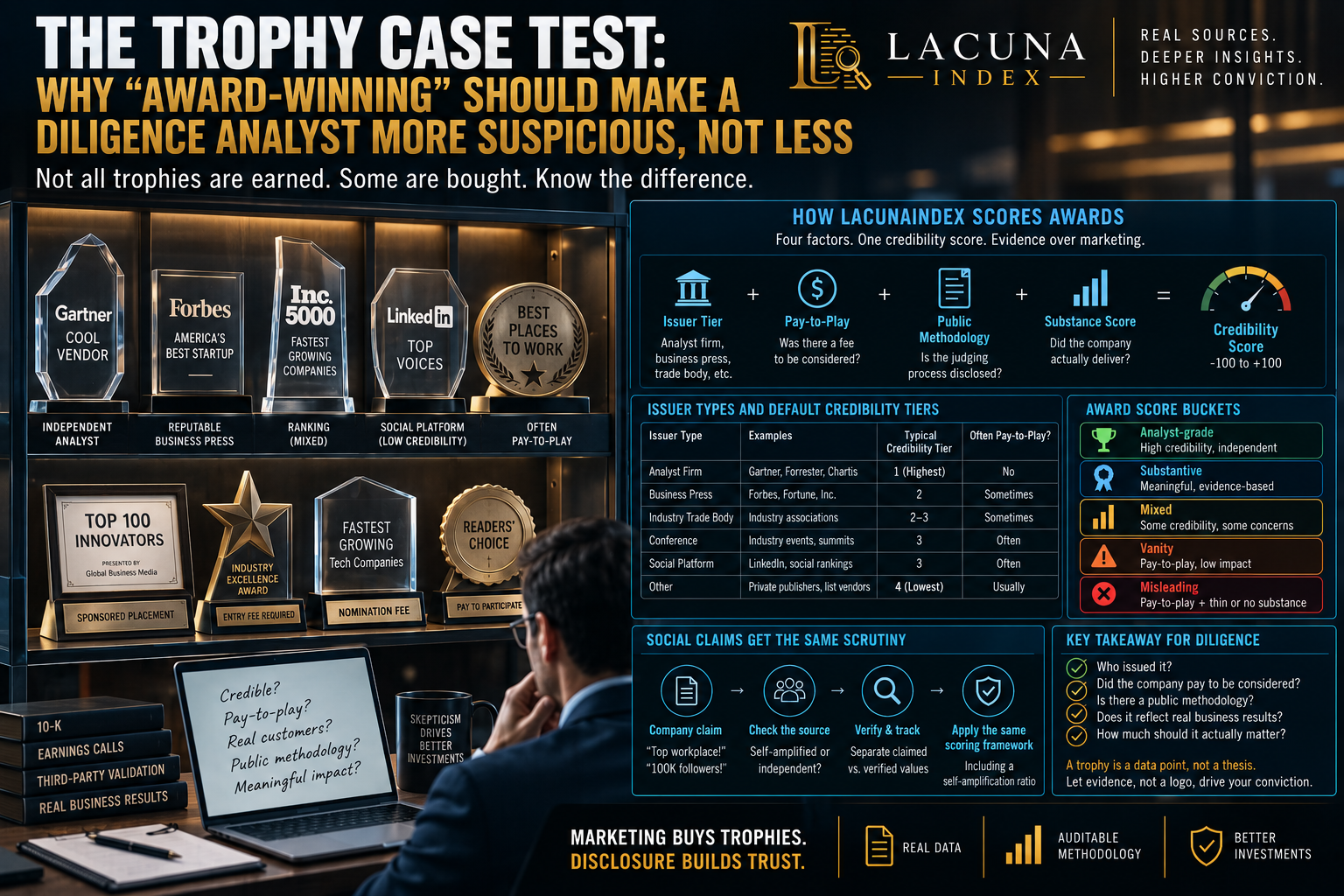
The starting point is a simple admin-managed table, lacuna.award_issuers, that classifies every organization we've seen hand out an award or "best of" placement — Gartner, Forrester, Fortune, an industry trade conference, a LinkedIn influencer list — into one of six issuer types (analyst firm, business press, industry trade body, conference, social platform, or other), and assigns it a default credibility tier from 1 (analyst-grade, like Gartner or Forrester) down to 4 (known pay-to-play operations). Critically, the registry also carries a default "pay-to-play" flag per issuer. When a new award entry references an issuer, it inherits that issuer's tier and pay-to-play default, so the classification work happens once, at the source, rather than being re-litigated for every company that cites the award.
This matters for a diligence workflow because it moves the judgment call — "is this issuer credible?" — out of the moment you're staring at a specific company's slide deck (where confirmation bias is strongest) and into a standing reference table you can audit independently of any one issuer under review.
The scoring function: substance times tier, with a continuous penalty for buying the badge
Once an award is tagged with its issuer's tier, LacunaIndex's award-scoring function combines four inputs — the issuer tier, whether the award is pay-to-play, whether the organizer discloses a public judging methodology, and a substance score (a 0-to-1 rating of whether the company actually shipped the product or achievement the award claims to recognize) — into a single net credibility contribution ranging from -100 to +100.
Two design choices are worth calling out because they reflect a deliberate stance on how forgiving or punitive this kind of scoring should be:
- Tier weighting is steep. A tier-1 analyst placement (Gartner, Forrester, Chartis, Everest Group) carries a full weighting of 1.0. A known pay-to-play organizer carries only 0.15 — even before any penalty is applied. One credible analyst placement is designed to outweigh roughly a dozen lesser trophies, on purpose.
- The pay-to-play penalty is continuous, not a cliff. Rather than zeroing out every paid award, the model applies a base penalty and then ramps it up the further the underlying substance score falls short of a 0.5 bar, with an additional penalty if the organizer also withholds its judging methodology. A pay-to-play award attached to a company that genuinely shipped something real lands as a mild negative. A pay-to-play award attached to vaporware — low substance, no disclosed methodology — is scored as actively misleading, not just neutral.
The output sorts every award into one of five buckets: analyst-grade, substantive, mixed, vanity (pay-to-play but essentially harmless), or misleading (pay-to-play stacked on thin or absent substance). An issuer's full award history then rolls up into a single composite line, and the rollup logic caps the credit any single company can earn from a large volume of low-tier trophies — the internal shorthand for this, in the code's own comments, is "one Gartner beats ten lesser trophies." A company with two dozen minor awards and no analyst-grade placement will not out-score a company with one credible one.
Social claims get the same treatment, with one more signal: who's doing the talking
Awards aren't the only form of manufactured social proof. A company's own social media claims — "named a top workplace," a follower-count milestone, a self-reported "fastest-growing" superlative — get tracked the same way, but with an added wrinkle: a self-amplification ratio, which measures what share of the citations behind a claim are the company's own posts versus independent, third-party coverage. A claim that is 90% self-amplified and has never been verified by a third party is flagged distinctly from one that has been independently confirmed — the platform separates "claimed" values from "verified" values wherever both exist, rather than taking the claimed number at face value.
Why this matters more than the trophy slide itself
All of this — awards, analyst placements, social claims — is deliberately weighted as a minority input into LacunaIndex's overall issuer credibility composite: partnerships and substantive third-party validation carry the majority of the weight, with awards and social recognition together contributing a supporting share. That ordering is itself the point for a diligence analyst. Recognition claims are the cheapest form of social proof to manufacture — a check to a pay-to-play publisher buys a logo for the deck in a way that a real enterprise partnership, a shipped integration, or an independent analyst evaluation cannot be bought. Any research process — human or automated — that treats "won an award" as equivalent evidence to "signed by an independent evaluator with a published methodology" will systematically overrate the companies most willing to spend on their own trophy case.
The practical takeaway for anyone running diligence, whether manually or with an AI research assistant, is to ask three questions before letting an award slide move a thesis: who issued it, did the company pay to be considered, and is there a public methodology behind the placement. If the answer to the middle question is yes and the answer to the third is no, the badge is marketing collateral, not evidence — and it should be weighted, and disclosed, accordingly.