
When Buybacks Stop Being Bullish: Broadridge, GM, and the Capital Allocation Test
Two companies can buy back stock aggressively and tell completely different stories. The signal isn't the size of the authorization — it's whether cash flow, reinvestment, share retirement, valuation discipline, and operating performance confirm what management wants investors to believe.
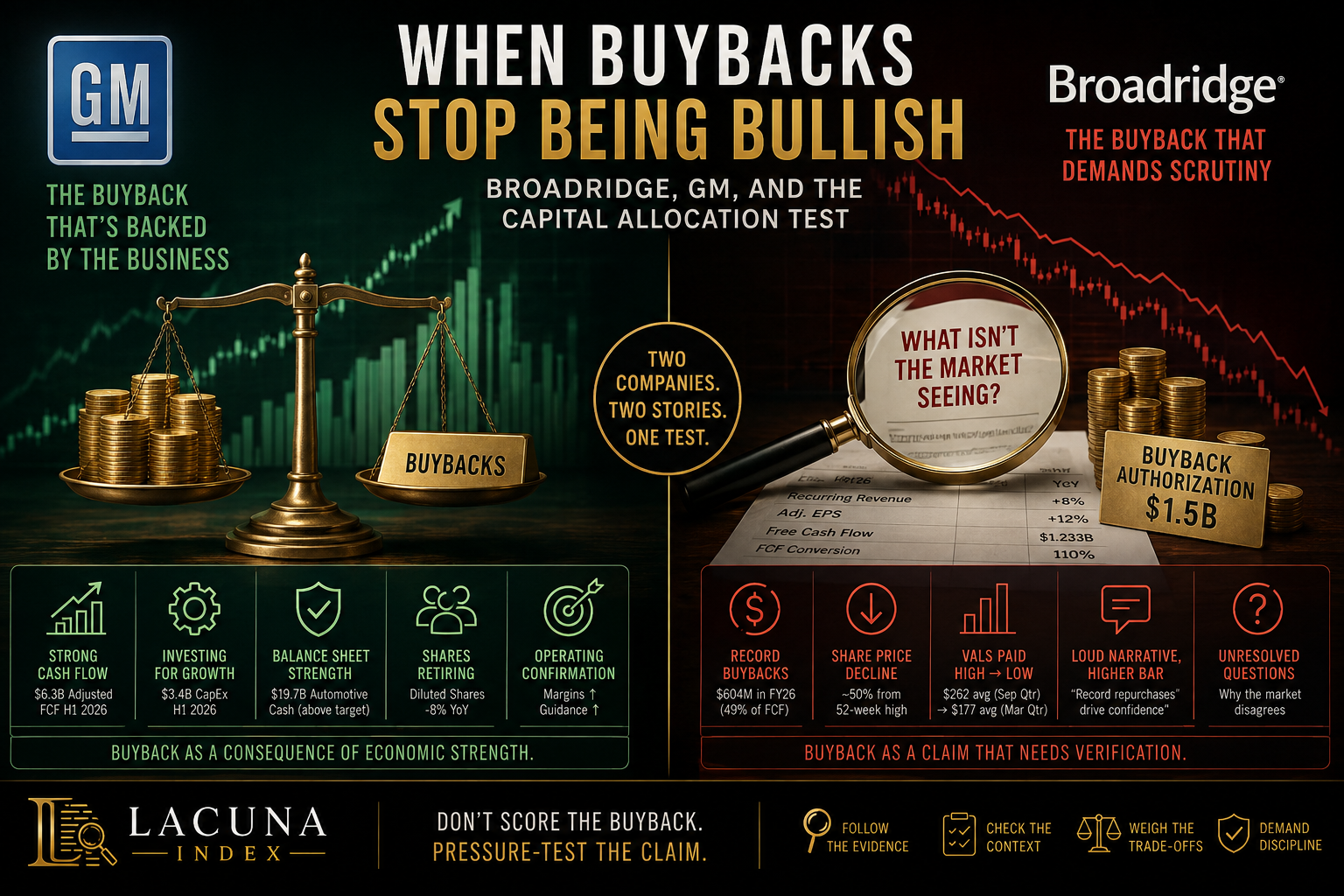
When Buybacks Stop Being Bullish
Broadridge, GM, and the Capital Allocation Test
A company buying back its own stock sounds bullish.
Management knows the business. It controls the cash. If it is willing to spend hundreds of millions — or billions — buying its own shares, the obvious interpretation is confidence.
But that logic skips an important step.
A buyback is not proof that a stock is cheap.
It is management making a capital-allocation decision with shareholder money.
And that decision should be tested exactly like any other investment.
What price did management pay?
Could the company afford it?
Did the share count actually decline?
Was the business still being adequately funded?
Did operating performance subsequently support the decision?
And, perhaps most importantly, did management's rhetoric about the buyback exceed the economic evidence behind it?
Two companies buying back stock aggressively in 2026 — General Motors and Broadridge Financial Solutions — provide a useful illustration.
They are not operating peers.
That is not the point.
This is a comparison of capital-allocation behavior.
And the two buybacks tell very different stories.
Story One: When the Business Confirms the Buyback
General Motors has been repurchasing stock aggressively.
GM repurchased approximately $800 million of shares during the first quarter of 2026 and another $2 billion during the second quarter, bringing first-half repurchases to roughly $2.8 billion.
That is substantial.
But a buyback should never be examined in isolation.
Around GM's repurchases sits a broader body of evidence.
During the first half of 2026, GM generated approximately $6.3 billion of adjusted automotive free cash flow while continuing to spend billions on capital expenditures.
It maintained substantial automotive liquidity.
Its North American operating margin improved.
Management increased its 2026 earnings and cash-flow expectations.
And the company's diluted share count fell materially year over year.
The sequence matters:
Business performs → cash is generated → reinvestment continues → liquidity remains strong → excess capital buys stock → shares actually disappear → operating expectations improve
The buyback is not being asked to prove the investment thesis.
The operating business is confirming the buyback.
That is a very different signal.
Story Two: Strong Numbers, but a Market That Isn't Confirming Them
Broadridge is more complicated.
Its fiscal 2026 headline results look strong.
Recurring revenue increased.
Adjusted earnings per share increased.
Free cash flow reached approximately $1.23 billion.
And Broadridge spent approximately $604 million repurchasing shares — dramatically more than the prior year.
The company also produced real share retirement. Period-end shares outstanding declined from approximately 117.1 million to 114.0 million.
So this is not simply a case of a company spending heavily on repurchases while stock-based compensation replaces everything it buys.
Broadridge actually reduced the share count.
Management also drew investors' attention to the activity, explicitly highlighting record share repurchases alongside its strong free-cash-flow conversion.
The board subsequently authorized another $1.5 billion repurchase program.
Taken alone, that sounds like confidence.
But then there is another piece of evidence:
the stock.
Broadridge shares have been dramatically repriced from their previous highs.
That creates a gap between the story told by the financial results and the story told by the market.
And gaps are where diligence becomes interesting.
$263 Versus $177
Broadridge's own filings provide an unusually useful capital-allocation test.
During the September 2025 quarter, the company repurchased approximately 571,000 shares at an average price of $262.92.
Several months later, with the stock significantly lower, Broadridge purchased approximately 1.13 million shares at an average price of $177.10.
There are two ways to interpret that.
The simplistic interpretation is:
Management bought stock at $263 and the market subsequently crushed the shares. Management badly misjudged its own valuation.
But that ignores the second transaction.
Broadridge bought roughly twice as many shares after the stock became substantially cheaper.
That is directionally what investors should want to see from a valuation-sensitive repurchase program.
If management believed its shares represented attractive value at $263, and nothing fundamental had deteriorated, they should be even more attractive at $177.
Broadridge's behavior appears consistent with that logic.
Which makes the larger question more interesting, not less.
Why has the market's assessment of Broadridge changed so dramatically while the company's reported operating performance, cash generation, and management confidence remain strong?
That is the question the buyback cannot answer.
It only tells investors where to start looking.
The Mistake Investors Make With Buybacks
The standard reasoning goes something like this:
Management is buying stock. Management knows the company. Management must believe the shares are undervalued. Therefore, the stock is undervalued.
Every step after the first one is an assumption.
Management can misjudge valuation.
Repurchases can be used to increase EPS through a smaller denominator.
They can compensate for heavy stock issuance.
They can reflect a shortage of attractive internal investment opportunities.
They can be funded at the expense of the balance sheet.
And enormous repurchase authorizations can generate headlines without producing anything close to equivalent actual purchases.
A buyback therefore should not be interpreted as an answer.
It should trigger a series of questions.
The Buyback Integrity Test
Before treating a repurchase program as bullish, an investor should examine at least seven things.
1. Can the company afford it?
Start with cash.
Not adjusted EPS.
Not the authorization.
Not management's description of shareholder returns.
Cash.
Compare actual repurchases with free cash flow.
Then add dividends.
Then examine debt.
A company repeatedly distributing more cash than it generates while increasing leverage deserves a very different interpretation from one returning genuine excess capital.
2. Is the business still being funded?
Capital returned to shareholders has an opportunity cost.
The relevant question isn't simply:
How much did the company repurchase?
It is:
What didn't the company do because that dollar went toward repurchasing stock?
For an industrial company, examine capital expenditures.
For technology and financial-services companies, the more relevant evidence may include:
- product development
- internally developed software
- acquisitions
- R&D
- platform modernization
- infrastructure investment
- strategic hiring
The best buybacks occur after economically attractive internal investments have been funded, not instead of them.
3. Did shares actually disappear?
This may be the simplest test and one of the most frequently ignored.
A company can announce billions in repurchases while simultaneously issuing large amounts of equity compensation.
The press release reports the gross number.
Shareholders experience the net number.
Always reconcile:
Cash spent on repurchases → shares purchased → shares subsequently issued → ending diluted share count
Gross repurchases are an activity metric.
Net share retirement is the economic result.
4. Did management buy more when the stock became cheaper?
This is where buyback behavior becomes particularly revealing.
Imagine management aggressively buying shares at $250.
The stock falls to $175.
Management continues telling investors that the underlying business remains strong.
But repurchases suddenly stop.
Something does not reconcile.
If $250 represented attractive value, then $175 should ordinarily represent better value — assuming the business thesis has not materially changed.
If management stops buying, investors should ask why.
If the thesis changed, what changed?
If liquidity disappeared, why?
If leverage became a concern, what created it?
If management's confidence changed, why hasn't the narrative?
Buyback behavior across different stock prices can reveal more than the authorization itself.
5. Is the operating business confirming management's decision?
This is where the GM example becomes useful.
The buyback exists alongside improving operating evidence.
Margins strengthened.
Cash generation remained substantial.
Reinvestment continued.
Liquidity remained strong.
Guidance improved.
Shares were actually retired.
The repurchase is one component of a broader economic story.
Broadridge also reports strong operating metrics.
But the market has nevertheless sharply repriced the company.
That does not prove Broadridge's reported performance is misleading.
It means investors should investigate the divergence rather than allowing the buyback to resolve it for them.
6. How loudly is management talking about it?
This is where buybacks can move from capital allocation into narrative management.
There is a difference between:
We repurchased shares as part of our capital-allocation framework.
and:
Our record repurchases demonstrate our tremendous confidence in the value of the company.
The second statement is asking the investor to interpret the buyback as evidence.
Once management does that, the burden of proof changes.
Call it Buyback Narrative Intensity.
Look for repeated references to:
- record repurchases
- confidence
- shareholder value
- undervaluation
- significant authorization
- EPS accretion
- returning capital
Then compare the language with the economics.
Did shares actually decline?
Was the purchase price disciplined?
Did free cash flow fund it?
Did leverage remain appropriate?
Was reinvestment maintained?
Did subsequent operating performance support the decision?
The more management brags about the buyback, the more aggressively investors should pressure-test it.
7. What is the market disagreeing about?
A falling stock price is not proof that management is wrong.
Markets get things wrong constantly.
But when a company reports:
**strong revenue growth
- rising earnings
- strong free-cash-flow conversion
- aggressive repurchases
- continued management confidence**
while investors simultaneously assign the company a dramatically lower valuation, the disagreement itself becomes evidence.
There are several possible explanations.
The market may be wrong.
Prior expectations may simply have been excessive.
Organic growth may be weaker than headline growth.
Acquisitions may be contributing more than investors previously appreciated.
Margins may be less durable.
Competitive threats may be increasing.
Future growth may not justify the old valuation.
Cash-flow quality may deserve closer examination.
Or the decline may have created exactly the opportunity management believes it has.
Those are hypotheses.
The buyback does not settle them.
Don't Score the Buyback. Pressure-Test the Claim.
This is the larger lesson.
There is no universal percentage at which buybacks become excessive.
A company repurchasing 7% of its market capitalization may be making an exceptional capital-allocation decision.
Another repurchasing 2% may be destroying value.
The amount is not the signal.
The relationship between the buyback and the surrounding evidence is the signal.
A healthy repurchase usually has multiple forms of confirmation:
Cash supports it. Reinvestment survives it. The balance sheet withstands it. Shares actually disappear. Management responds rationally as valuation changes. Operating performance confirms the thesis. And the rhetoric does not exceed the economics.
GM currently provides many of those confirmations.
Broadridge also provides several.
And that is precisely what makes Broadridge interesting.
The appropriate conclusion is not:
Broadridge is hiding something.
The evidence does not establish that.
The more defensible conclusion is:
Something has not reconciled yet.
Strong reported performance.
Strong cash generation.
Aggressive buybacks.
Management confidence.
And a market that has substantially changed its mind.
That gap deserves investigation.
Because good diligence is not about choosing the story management tells or automatically choosing the story the market tells.
It is about identifying where the two stories stop agreeing.
And then digging until you understand why.
A buyback is not management proving that its stock is cheap.
It is management making another claim that investors should verify.